
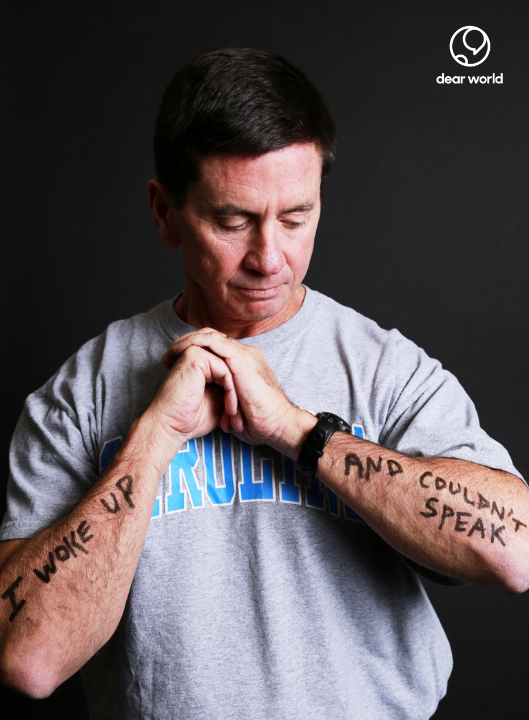
Robert: Steve, can you take me back to the first time you experienced Dear World? Steve: We were on a boat on Lake Michigan during one of our big incentive meetings. It’s crazy that you were able to set up on a boat by the way. Kind of a unique setting unto itself. You and your team had spoken earlier in the day, and then you set up the photography experience right there on the boat. I remember hearing the buzz of people coming back from it, talking about how cool it was, sharing what they'd written on their arms. I got pulled into a photo with Steve Maritz and David Peckinpaugh. They were like, "We've got to do something together." So we split our tagline across our hands: Work hard, have fun, and get the job done. But then later I was talking to a woman who was repping one of our hotels in Mexico. Somehow it came up that I'd had cancer in 2011. I have no idea how. But when I described it, she said, "That's the exact same cancer my husband had." We just talked through all of it. The challenges that come from treatment. The blessing that both he and I had made it through. And then it came down to something deeper: you're put in each other's lives for a reason. I can't remember what she wrote, but I wrote no coincidences. A connection born from a chance conversation, centered around something pretty darn tragic, that brought us together. Robert: Can you tell me a little about what it was? The cancer? Steve: I had head and neck cancer. It had metastasized to my lymph nodes. They had to do a neck dissection, which is a nasty surgery. They took out 21 lymph nodes. Then 30 days of radiation after that. I woke up and I couldn't speak. That's a hard thing to describe to someone who hasn't been through it. You come out of this surgery where they've been inside your neck, and you can't do the most basic thing a person does. You can't talk to the people you love. You can't tell your kids it's going to be OK. You're just there, silent, trying to will yourself back. Robert: Your sons, how old were they? Steve: Eighth grade and sixth grade. I was facing this and thinking, "Am I going to get to see them grow up?" Now, almost 15 years on, I feel incredibly fortunate. My older son is doing his second year of residency in orthopedic surgery at Washington University in St. Louis. My younger son is finishing his law degree at Saint Louis University. I've been able to be part of all of it. They didn't miss me, and I didn't miss them. Robert: How did that experience shift your perspective? Steve: Every day is very important. But the outcomes from it are just less critical. That's one of the lessons I keep trying to remind myself of. Every setback, it's still the incredible gift that life is, every single day. The universe is really trying to conspire to give you every possible benefit. You just have to be open to it. My wife and I will be married 33 years this year. As opposed to not making it that far. So that's a good thing too. We’ve grown and shared all of these experiences post cancer that have brought us deeper love and meaning in our lives and our friends and family. Robert: You mentioned the universe putting good things in your path. Was cancer also that? Because it feels, in a way, like friction. Steve: Yeah. And I think that's even in my outlook. I actually still have every email I received during that time. Every note of encouragement, every message telling me to hang in there. I filed them all away in my personal folders under a file called My Blessing. Because I had to view cancer as just that. I had to view it as a gift in order to face up to it, get through it, work my way into acceptance, and deal with the aftermath. Life is a choice. How you view cancer is a choice. Robert: That folder. My Blessing. Have you gone back to it? Steve: I haven't looked at that file in ages. I'm sure any of them would surprise me now. Robert: That's kind of what I love about it. The one that surprises you today. Steve: Yeah. I'll dig around in there. Robert: So what did it give you, in the end? Steve: It woke me up. It took me out of my old life and put things into technicolor. I got to wake up this morning. It's a beautiful spring day in St. Louis. Regardless of the difficult things I have to do in my day-to-day job, it's pretty darn good. All too often we get bogged down in the humdrum and our eyes aren't open to see what's being put in our path. Going through cancer, feeling your mortality, it changes that. Every day past that last treatment that I've been clean and clear of cancer, it truly is a blessing. If I'm giving my best effort, doing what I can to honor my presence on the planet, then whatever happens, happens. I can't be in charge of the outcomes. No coincidences. Just gifts, if you're open to finding them. A note from Robert: A few days after our conversation, Steve sent me a passage from Kevin Kelly. "This is the quote I was telling you about," he wrote. I read it and understood why he'd kept it close. Kelly wrote about how spiritual faith, the kind he most respects, doesn't rest on hope. It rests on gratitude. That the people whose character he most admires carry a sense of knowing they are indebted, of resting in thankfulness. They recognize they are at the receiving end of an ongoing lucky ticket called being alive. When they worry, it isn't about doubt. It's about whether they might squander the gift. And then Kelly lands on the thing Steve had been circling the whole conversation: no matter how bad the weather, soiled the past, broken the heart, all that is behind the universe is conspiring to help you, if you will let it. Steve filed his cancer emails in a folder called My Blessing. He wrote No coincidences on his arm on a boat on Lake Michigan. He woke up from surgery and couldn't speak. And then he spent the next 15 years learning to say the same thing, over and over, in every way he could: Life is a gift. Write your future, Robert About Steve O’Malley Steve O’Malley is the COO of Maritz. He is a past Chair of the MPI International Board of Directors (2019 & 2020), helping to drive the future of the association and the industry in that role. He is a past President of the Site International Foundation and was awarded the Richard Ross Past Presidents award in 2019 by Site Global in recognition of outstanding service to the incentive travel industry. He was inducted into the Events Industry Council Hall of Leaders in 2023 in recognition of a lifetime of service to the events industry. In 2024, Steve received the MPI Industry Leader award in recognition of his service to MPI and the events industry. And he tells us that most people like him! PS: Want to forward or share this story to someone who might need it? Use the same link: https://stories.dearworld.com/book/i-woke-up-and-couldn-t-speak
I woke up and couldn't speak
“60 seconds with Steve O'Malley, COO of Maritz.”
Robert X. Fogarty, Founder of Dear World
Jun 2, 2026·3 min read
Bring Dear World to Your Event
Book Robert’s Award Winning Keynote Speech & Dear World Portrait Shoot
Looking to inspire, connect, and engage your people in ways you never thought possible? Talk to our team about bringing the Dear World keynote and portrait shoot experience to your next event.
Talk to Our Team